
Sydney residents love footpath gardens
by
Michael Mineotas, intern with Sustainable House
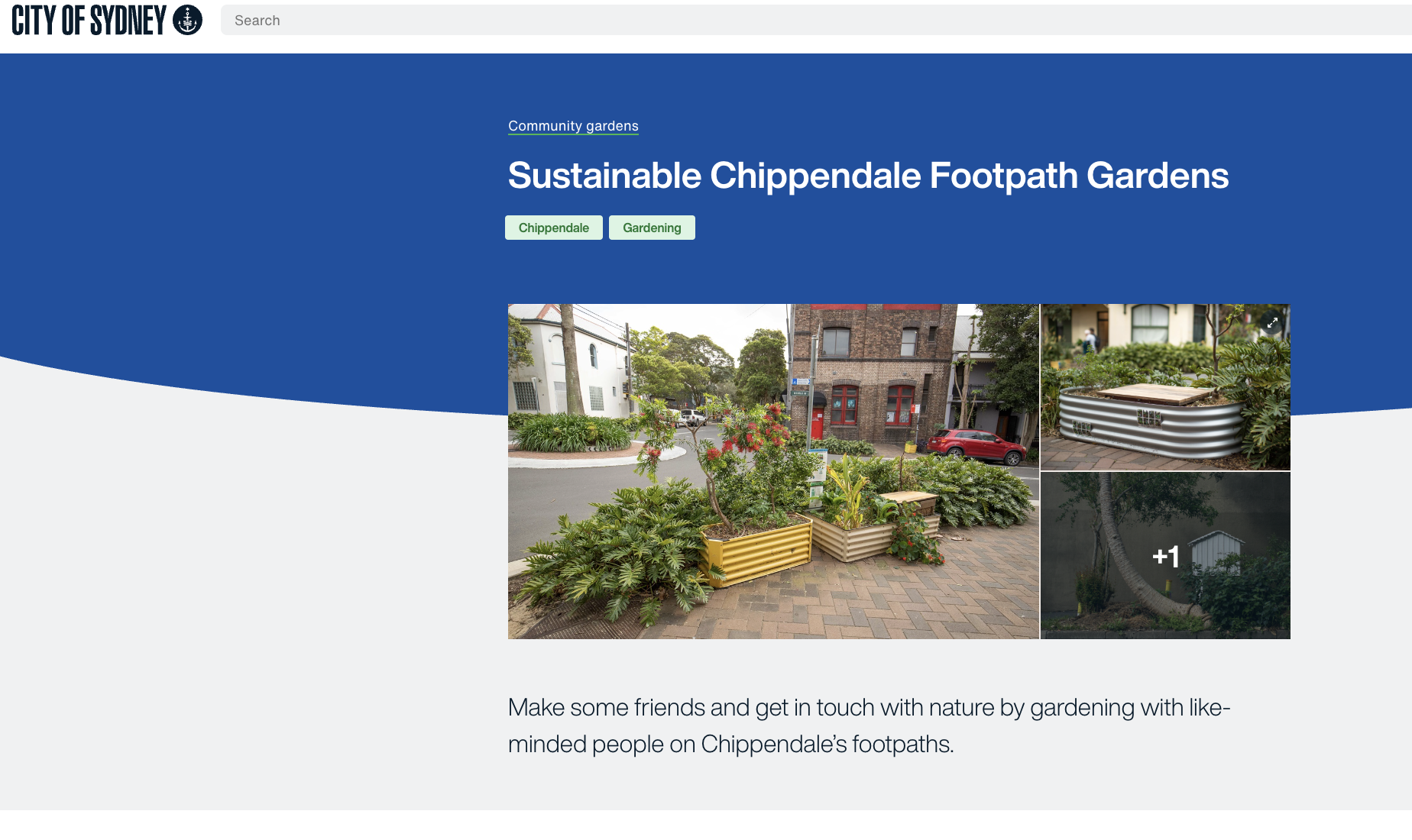
• Sustainable Chippendale Footpath Garden, one of 22 community gardens in the City of Sydney
Sydney Residents Love Footpath Gardens — And Here’s Why
Sydney’s footpath garden policy is a great example of how city councils and communities can work together to improve our urban environment. The policy allows residents to create gardens on public footpaths without requiring City approval.
As an international student from Florida, I was impressed not only by the strong sense of community these gardens create, but also by the trust the City of Sydney places in its residents by giving them this freedom.
Recent surveys and research show that residents are excited about community garden spaces and want more of them in public areas.
Community Gardens Are in High Demand
A survey of over 5,000 Sydney residents revealed strong support for urban green spaces:
85% want more street gardens and flower boxes
82% support urban farming on rooftops
(City of Sydney, 2021)
These numbers show that people are not only interested in seeing greenery in their neighbourhoods but also in actively participating. Residents value gardens for their beauty, health benefits and the sense of community they create.
Composting and Gardens Go Hand in Hand
Community composting is another area residents care about deeply. In a City of Sydney survey of 216 people, nearly half ranked community composting as extremely important. Those who supported it most cited two main reasons:
Reducing food waste and keeping it out of landfill
Personal experience in taking food scraps to local gardens
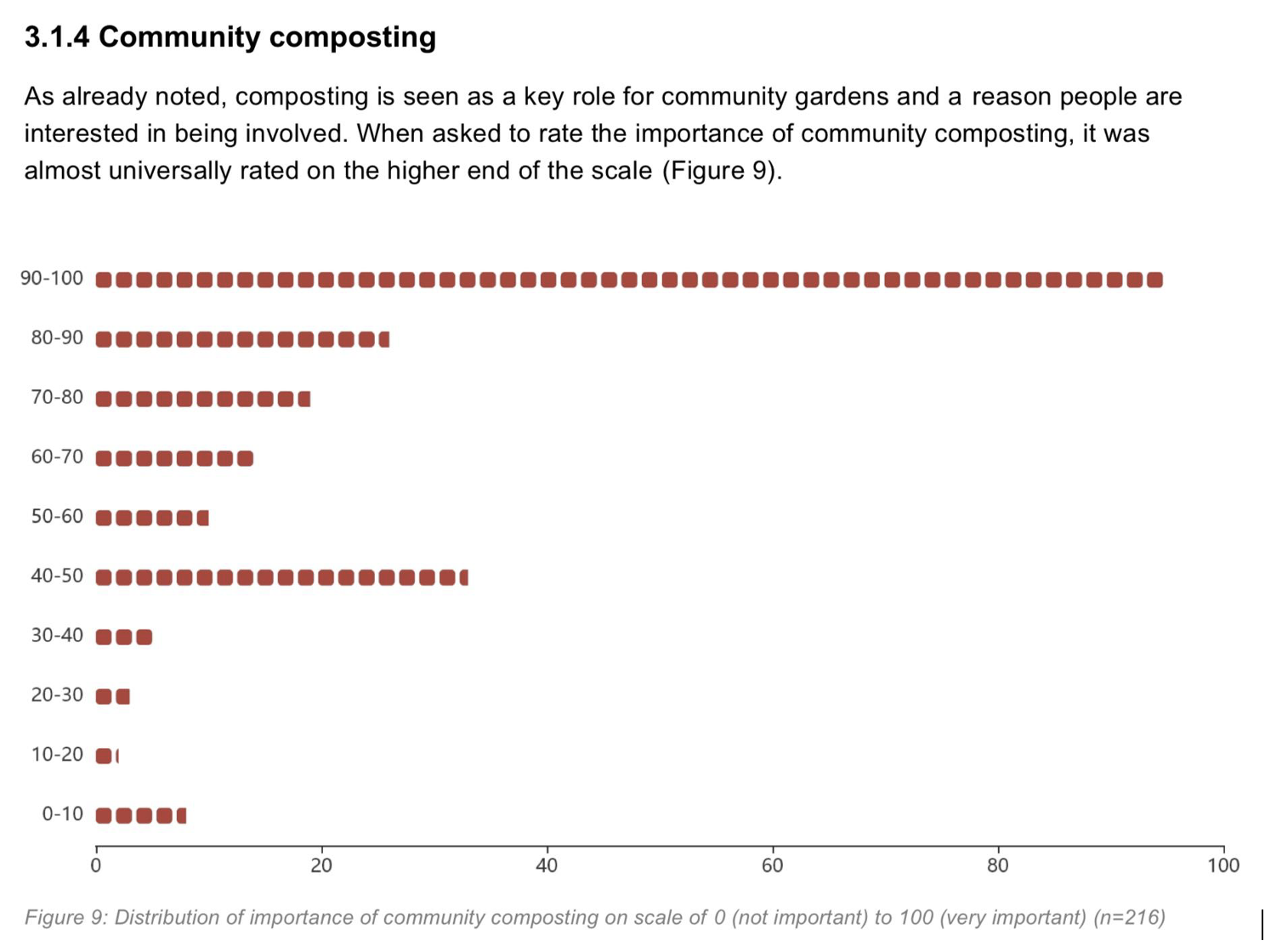
• Community composting top score
While some respondents mentioned barriers, like limited access in apartment buildings or concerns about pests, there was widespread support for accessible composting bins and programs. Many also saw a role for the City in promoting education about what can be composted and how to participate (City of Sydney, 2021; EPA NSW, 2025).
Health and Wellbeing Benefits of Gardening
Gardening isn’t just beneficial for the environment — it has significant positive impacts on people’s health and wellbeing.
Physical Health: Gardening helps build strength, restore dexterity, and provides aerobic exercise. In addition, the fresh fruits and vegetables grown through gardening contribute to a healthier diet (Vaz et al., 2005).
Mental Health: Spending time interacting with plants has been shown to reduce stress, fear, anger, and sadness. It also lowers blood pressure and muscle tension, contributing to overall mental wellbeing (National Library of Medicine).
Cognitive Benefits: Regular gardening activities can help delay the symptoms of dementia, supporting cognitive health in older adults (Simons et al., 2006).
Social Benefits and Vitamin D: Gardening combines physical activity with social interaction and exposure to sunlight. This not only strengthens social connections but also increases vitamin D levels, which supports overall health (Sowah et al., 2017).
Why This Matters for Sydney
The strong support for footpath gardens and community composting shows that these initiatives do more than beautify streets. They create healthier, happier, and more connected communities. Residents are excited about these spaces and want to see them thrive. By expanding gardens, supporting composting, and providing education, Sydney can continue to create vibrant, sustainable public spaces that residents love, and actively participate in.
By continuing to expand footpath gardens, support community composting, and provide education, Sydney can create vibrant, sustainable public spaces that residents love, and actively participate in.
by
Michael Mineotas, intern with Sustainable House
References
City of Sydney. Community Gardens Insights Report. Sydney: City of Sydney; 2021. https://www.cityofsydney.nsw.gov.au/-/media/corporate/files/publications/research-and-reports/community-gardens-insights-report.pdf?download=true
EPA NSW. Waste levy — Levy regulated area and levy rate. Sydney: NSW EPA; 2025. https://www.epa.nsw.gov.au/Your-environment/Waste/waste-levy/levy-regulated-area-and-levy-rate
National Library of Medicine. Mental and physical health benefits of gardening.https://www.ncbi.nlm.nih.gov/pmc/articles/PMC6334070/
Simons LA, Simons J, McCallum J, Friedlander Y. Lifestyle factors and risk of dementia: Dubbo Study of the elderly. Med J Aust. 2006;184:68–70. https://pubmed.ncbi.nlm.nih.gov/16411871/
Sowah D, Fan X, Dennett L, Hagtvedt R, Straube S. Vitamin D levels and deficiency with different occupations: a systematic review. BMC Public Health. 2017. https://pubmed.ncbi.nlm.nih.gov/28637448/
U.S. Environmental Protection Agency. Pay-As-You-Throw: A Survey of Implementation Experiences. Washington (DC): U.S. EPA; 2000.
Vaz M, Karaolis N, Draper A, Shetty P. A compilation of energy costs of physical activities. Public Health Nutr.2005;8(7):1–8. https://www.cambridge.org/core/services/aop-cambridge-core/content/view/3BB7478CDE6E2F36384B8CB5554EC43E/S1368980005001400a.pdf
Wright C, Halstead JM, Huang JC. Estimating Treatment Effects of Unit-Based Pricing of Household Solid Waste Disposal. Agric Res Econ Rev. 2019;48(1):21–43. https://www.cambridge.org/core/journals/agricultural-and-resource-economics-review/article/estimating-treatment-effects-of-unitbased-pricing-of-household-solid-waste-disposal/BCB860759B12645C695E1C519B61AB9E